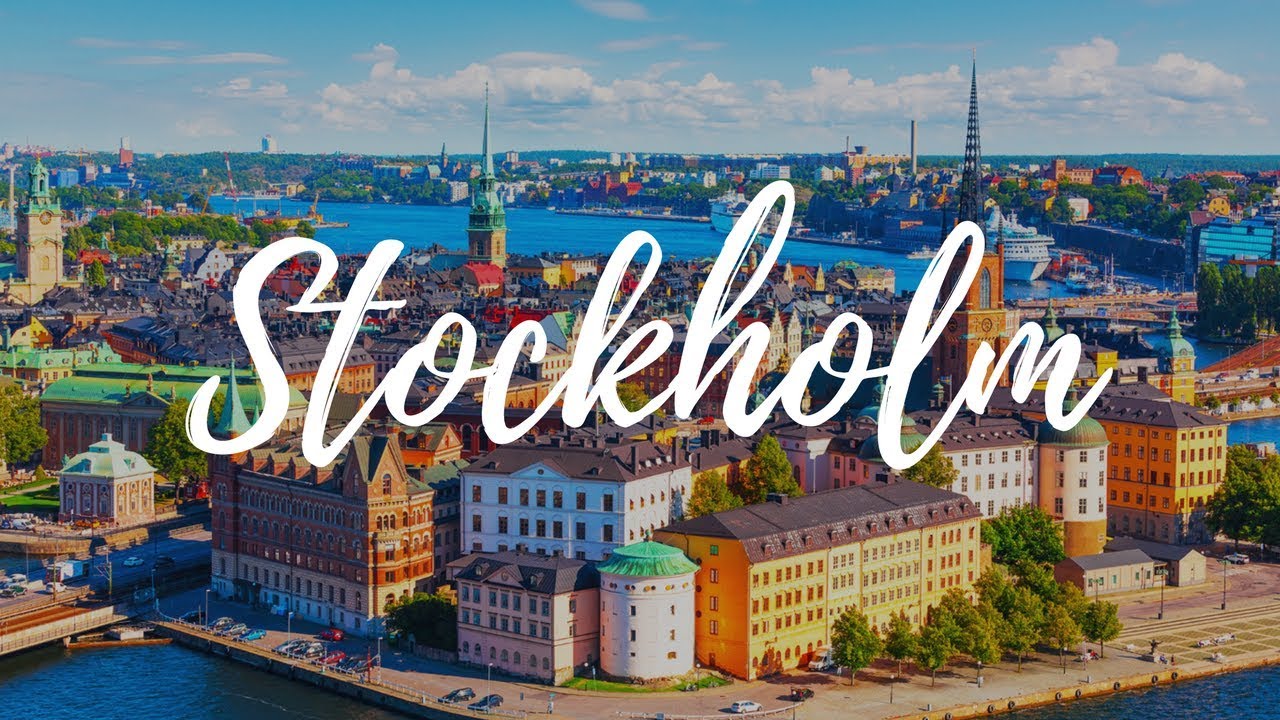
 Stockholm is the capital and largest city of Sweden, with nearly 2 million inhabitants within its vicinities.
The inner city is made up of 14 islands connected by some 50 bridges on Lake Mälaren, which flows into the brackish Baltic Sea, and passes the Stockholm archipelago with some 24,000 islands and islets. Stockholm is a cosmopolitan place with both classical and modern architecture, and a captivating Old Town, Gamla Stan. Over 30% of the city area is made up of waterways, and another 30% is made up of green spaces. Air quality is fourth best of the European capitals - behind Zurich, Copenhagen and Vienna.
Stockholm is not the oldest town in Sweden. As Sigtuna, Sweden's first capital, was sacked by pirates in 1187, the Swedes built up fortresses along the inlet of Mälaren, and Birger Jarl (Jarl is a title corresponding to British Earl) had a fortress built on an island later known as Gamla Stan. The first records of Stockholm were written in 1252 by Birger. As the land raised, the Stockholm straits became the only waterway between Mälaren and the Baltic Sea during the 15th century, replacing Uppsala as the effective capital. Since King Gustavus Vasa liberated Stockholm in 1523, Stockholm has remained Sweden's most important centre of commerce, though Gothenburg later became the largest international port. During the 17th century, Stockholm was the base of the Swedish Empire, with a land area twice the country's current size, nearly encircling the Baltic Sea.
The city contains buildings from all ages since the 13th century. Like the rest of Sweden it was untouched by the World Wars, but particularly between 1955 and 1975, hundreds of old buildings in Norrmalm were demolished in a large-scale modernization process, encouraged by similar projects in other European cities. Since then, only infills and a few areas have been developed with new architecture in central Stockholm.
With about 80,000 university students at more than twenty universities and university colleges, Stockholm is the largest university city in the Nordic countries. The largest institutions of higher education are Stockholm University (Stockholms universitet), the Royal Institute of Technology (Kungliga tekniska högskolan), and Södertörn University College (Södertörns högskola). Two more specialized universities are Karolinska institutet, a world-class medical university, and Stockholm School of Economics, one of the most prominent business schools in Europe. There are also several fine arts university colleges. Study in Stockholm has information about university studies in Stockholm. Studying in Sweden is free for EU-citizens.
Stockholm features a large variety of restaurants. However, dining in Stockholm can be expensive, if you aim for something else than the fast food bars, the run-of-the-mill British-style pubs or the ethnic restaurants that dominate the budget bracket. Be prepared to pay around 175-250 SEK or more for most main courses at quality restaurants. If you are on a tight budget, self-catering is probably the best option.
Taking a break for coffee and a biscuit is a Swedish tradition, commonly called fika in Swedish, and there are many coffee-bars around the city. Traditional Swedish filter coffee is relatively strong when compared to American, but a far cry from the Italian espresso. Espresso, caffe latte, cappuccino and other varieties of Italian coffee are generally available. If you prefer tea, note that many cafés only offer a few flavours, but generally some black, red and green teas.
The cost for drinking out in Stockholm can vary a lot. Expect to pay around 30 SEK in the cheapest pub (55-75 SEK in a trendier club or pub) for a beer or cider, and at least 95-150 SEK for a long-drink or cocktail in a club. Bars usually have no cover charge, but may have an arbitrarily set (and arbitrarily enforced) minimum age limit (usually 21 or 23, sometimes as low as 18, other times as high as 27), while clubs usually charge 50-200 SEK at the door (or more at special performances). Long, and very slow moving lines tend to form outside most popular clubs - expect having to wait as much as 1 hour or more if going to a trendy place after midnight, even if raining or snowing. Don't forget to bring an ID, as bouncers could at anytime ask for identification at the door in both pubs and clubs.
Stockholm is a safe city by international standards. As in other cities, however, you should avoid late-night walks through deserted areas of the city or through unlit parks.
Stockholm has an exciting night-life. As in most countries, being overly intoxicated is not accepted in most bars and clubs, and could lead to the security staff forcibly ejecting the trouble-maker. Swedish people tend to binge-drink, and as usual, alcohol might fuel violence.
STOCKHOLM - Sweden Travel Guide | Around The World travel time from manila to korea | |
| 1 Likes | 1 Dislikes |
| 29 views views | 185 followers |
| Travel & Events | Upload TimePublished on 16 Mar 2018 |

Không có nhận xét nào:
Đăng nhận xét